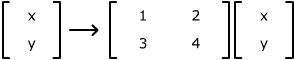
Earlier, we looked at matrix operators on R2 and R3 – transformations like
and
for example.
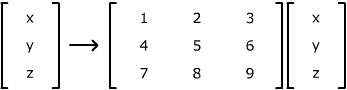
We can do the same for Rn: first represent any x in Rn as a column matrix.
|
As before, we can discuss the "geometry" of these operators, decompose them into simpler operators and so on. The basic ideas are the same; the computations just become more complicated.
We can also make the idea of matrix operators more general. Suppose that A is an m x n matrix, not necessarily square. If we continue to represent our vectors by column matrices, then the transformation r → Ar transforms n-tuples into m-tuples – instead of just moving vectors around inside the same space, it transforms them into vectors in a different space.
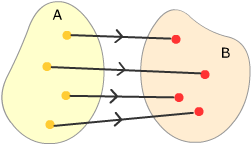
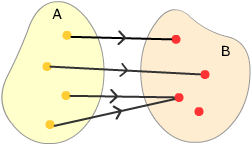
The way to think about such transformations is to think of them as functions.
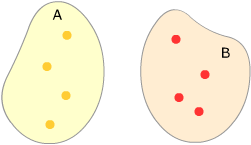
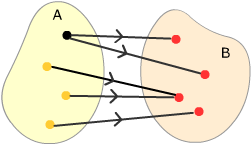
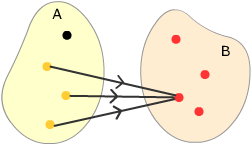
Review of functions. Suppose we have two sets A and B.
|
|
||||||
|
||||||
|
Multiplication by an m x n matrix transforms each vector in Rn into a single vector in Rm, so it is a rule that defines a function.
|
We can then think of matrix operators as matrix transformations for which the domain and codomain are two copies of the same space Rn.
In the next section, we'll look at these transformations in more detail.